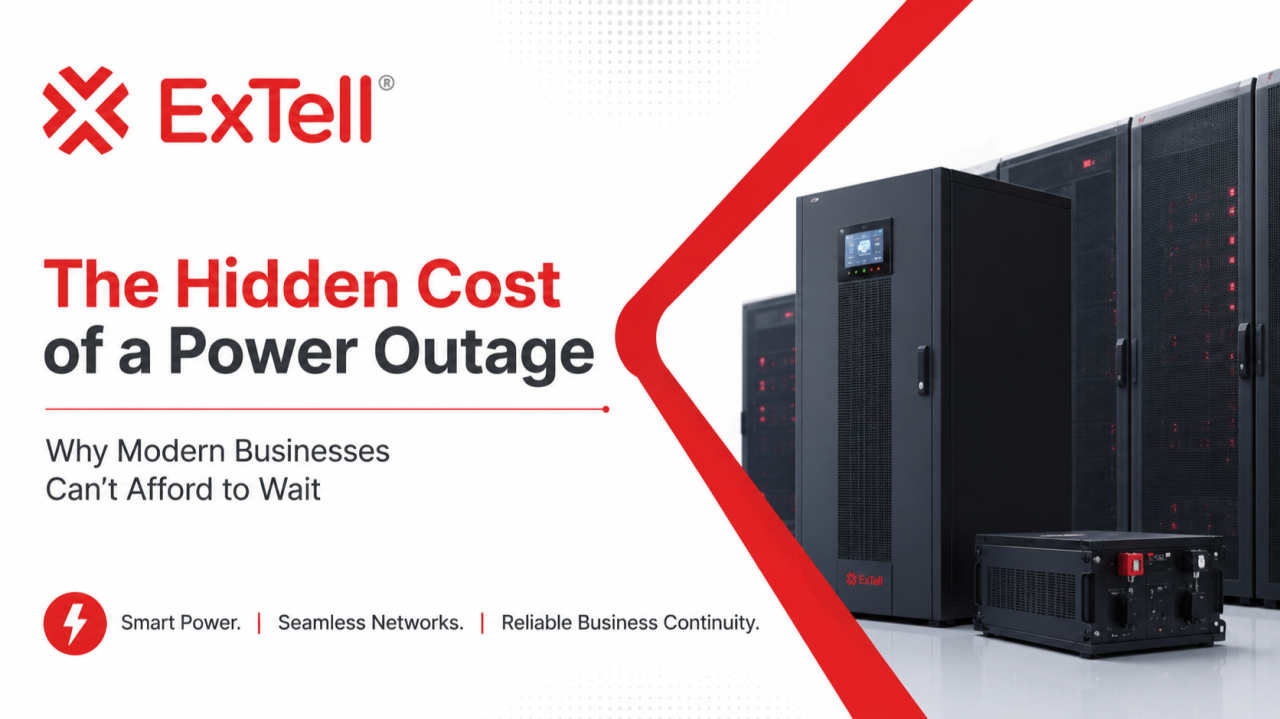
The Hidden Cost of a Power Outage
The Hidden Cost of a Power Outage: Why Modern Businesses Can’t Afford to Wait
Nobody thinks about power until the moment it fails.
The server room goes dark. The trading floor falls silent. The hospital’s monitoring systems switch to emergency mode. In that single instant — that gap between the last blink of normal operation and whatever comes next — an organisation discovers exactly how much it had taken for granted.
I have seen this moment play out across industries. And I can tell you with certainty: the damage begins long before the lights come back on.
What a Power Outage Actually Costs ?
Most financial models underestimate the true cost of downtime because they only count what’s visible.
They count the lost revenue from halted operations. The IT team’s overtime hours. The equipment that needs replacing. These are real, and they are significant.
What the spreadsheet rarely captures is the rest: the customer who calls during the outage and never calls back. The compliance audit that flags data inconsistency following an unplanned shutdown. The engineer who loses three hours of unsaved work on a deadline project. The hospital patient whose care timeline gets disrupted while teams scramble to restore systems. The reputational cost that doesn’t show up until the next contract renewal, when a competitor makes a quiet point about their 99.99% uptime record.
Downtime is not an event. It is a cascade. And for organisations operating in real-time environments — financial services, healthcare, manufacturing, logistics, telecommunications, data infrastructure — a cascade has a way of growing faster than the teams managing it.
The honest question every operations leader should be asking is not “What is the probability of an outage?” It is “If one happens tomorrow, how much of our business survives intact?”
The Shift That Changed Everything
A decade ago, most organisations treated power backup as insurance: important to have, uncomfortable to think about, renewed annually without much scrutiny.
That relationship has changed — fundamentally and permanently.
The digitalisation of enterprise operations means that power is no longer the infrastructure beneath the business. In most modern organisations, power is the infrastructure. Cloud connectivity, automated production lines, real-time data processing, distributed remote teams, AI-driven analytics — every one of these capabilities collapses without stable, uninterrupted electrical supply.
And the environments in which businesses operate have not become more forgiving. Grid instability, climate-driven weather events, ageing national infrastructure, and the sheer increasing density of power demand in urban and industrial zones mean that the frequency and duration of power disruptions are trending in the wrong direction across many of the world’s fastest-growing markets.
Organisations that have not modernised their approach to power continuity are not just exposed to risk. They are operating with an infrastructure debt that will eventually come due.
What “Power Protection” Actually Means in 2026
This is where the conversation often loses clarity, so I want to be specific.
Reliable power protection in a modern enterprise context is not simply about having a generator in the basement or a battery rack in the server room. Those solutions were designed for a different era of business complexity.
What forward-thinking organisations are building today is a layered approach:
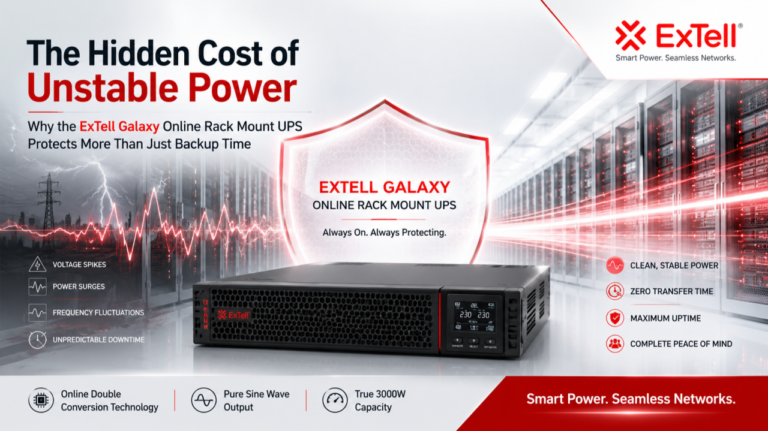
Continuous uptime architecture. Systems designed so that maintenance, switching events, and upstream grid fluctuations never reach the load. Online double-conversion technology, where critical equipment is powered entirely from a conditioned inverter rather than directly from the mains, represents the current standard for environments where even a 20-millisecond transfer gap is unacceptable.
Clean, stable power quality. Voltage sags, harmonic distortion, frequency fluctuations — these are silent killers of sensitive IT hardware. A UPS system with active input power factor correction and less than two percent total harmonic distortion does not just protect against outages. It protects the hardware from the ordinary imperfections in the power it receives every single day.
Intelligent management and visibility. Modern power infrastructure should be monitorable, manageable, and integrated into the organisation’s broader network management systems. SNMP, MODBUS, RS485 — these are not acronyms for the data centre specialist to worry about alone. They represent the organisation’s ability to see, predict, and respond to power events before they become incidents.
Scalability that matches business growth. One of the most consequential infrastructure decisions any growing organisation makes is whether its power architecture can scale without being replaced. Parallel-capable UPS systems — those that allow multiple units to share load and provide redundancy within a single coherent architecture — protect capital investment in a way that single-unit solutions simply cannot.
The Organisations Getting This Right
The businesses investing thoughtfully in power infrastructure today share a few characteristics.
They treat power continuity as a board-level risk, not purely an IT procurement decision. They have mapped the financial impact of specific downtime scenarios — not generic estimates, but modelled costs tied to their actual operations. They have had an honest conversation about the difference between their current backup power capability and what their current operations actually demand.
They also tend to work with partners, not just vendors. There is a meaningful difference between buying a box that gets installed and having a power infrastructure relationship — an ongoing engagement where system performance is monitored, capacity is reviewed as operations grow, and the organisation is never surprised by its own infrastructure.
A Final Thought on Competitive Advantage
There is a version of this conversation that stays entirely in the language of risk mitigation: avoid outages, protect data, maintain compliance. That framing is accurate but incomplete.
The other way to see reliable power infrastructure is as a foundation for capability. Organisations that have solved their continuity question can make digital transformation decisions, take on more operationally intensive clients, enter regulated markets, and scale their infrastructure footprint with confidence. Those that have not solved it carry an invisible constraint on every expansion decision.
In a competitive landscape where margins are tighter and client expectations around uptime are higher than they have ever been, the organisations that lead tomorrow are investing today in the infrastructure that makes their ambitions possible.
Power is not the exciting part of the technology story. But it is the part that everything else depends on.