On-Grid vs Off-Grid Solar Solutions for Residential, Commercial and Industrial Projects
Solar energy is helping homeowners, businesses, and industries reduce electricity costs and improve energy efficiency. However, choosing the right solar system is essential to achieve the expected savings and power reliability. Two common options are on-grid solar systems and off-grid solar systems.
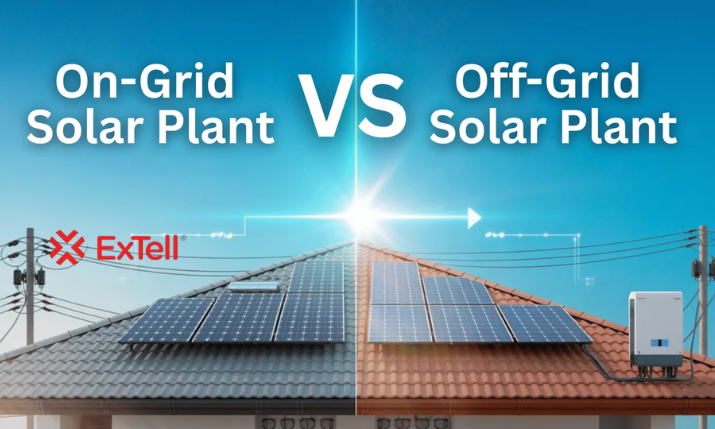
The main difference is their connection to the electricity grid. On-grid systems work alongside the utility grid and can export surplus electricity where permitted. Off-grid systems operate independently and use batteries to store energy for periods when sunlight is unavailable.
For residential, commercial, and industrial projects, the right choice depends on electricity consumption, grid reliability, backup requirements, available space, and project budget. This guide explains how both systems work and how to select the right solution for your needs.
What Is an On-Grid Solar System?
An on-grid solar system, also known as a grid-tied solar system, connects solar panels to the local electricity grid through a compatible inverter.
During daylight hours, the solar panels generate electricity for the property. If solar production exceeds the property’s immediate consumption, surplus electricity may be exported to the grid through an approved metering arrangement. At night or when solar generation is insufficient, electricity can be drawn from the grid.
Key Benefits of On-Grid Solar
- Lower initial investment: Batteries are generally not required, reducing equipment costs.
- Reduced electricity bills: Solar generation can reduce the amount of electricity purchased from the utility.
- Efficient energy use: Surplus electricity may be exported, depending on local regulations and the approved connection.
- Less battery maintenance: Without a battery bank, there are fewer storage components to maintain or replace.
- Suitable for larger projects: Systems can be designed for homes, offices, commercial buildings, and industrial facilities.
One important limitation is that a standard grid-tied solar system normally shuts down during a grid outage because of anti-islanding safety protection. Solar panels alone therefore do not guarantee electricity during a power cut.
What Is an Off-Grid Solar System?
An off-grid solar system operates independently of the utility electricity grid. It uses solar panels, a charge controller or suitable integrated power electronics, battery storage, and an inverter to supply electricity to connected equipment.
During the day, solar panels power the connected loads and charge the batteries when surplus energy is available. At night or during periods of low sunlight, the batteries provide stored electricity.
A generator may also be included to support longer periods of poor weather or unusually high energy demand.
Key Benefits of Off-Grid Solar
- Energy independence: The system can operate without a utility grid connection.
- Backup electricity: Batteries supply stored energy when solar generation is unavailable.
- Remote-site suitability: It can serve locations where grid access is unavailable or unreliable.
- Flexible system design: Battery capacity and solar generation can be planned around site requirements.
- Reduced dependence on grid supply: Properly designed systems can support essential loads during extended outages.
However, off-grid systems generally require a higher initial investment because of batteries and additional power-management equipment. Their performance depends on correct system sizing, battery condition, available sunlight, and energy consumption.
On-Grid vs Off-Grid Solar: Key Differences
| Feature | On-Grid Solar | Off-Grid Solar |
|---|---|---|
| Grid connection | Required | Not required |
| Battery storage | Usually not required | Required for stored-energy backup |
| During grid failure | Standard systems shut down | Can continue operating if properly designed |
| Initial cost | Generally lower | Generally higher |
| Excess solar energy | May be exported to the grid | Stored or used locally |
| Battery replacement | Usually not applicable | Must be included in lifecycle planning |
| Best suited for | Grid-connected properties | Remote or grid-unavailable locations |
| Main priority | Electricity savings | Energy independence |
Neither system is universally better. The correct solution depends on whether the project prioritizes lower electricity costs, reliable backup, or independence from the utility grid.
Which Solar Solution Is Best for Residential Projects?
For homes with reliable grid electricity, an on-grid solar system can be an economical way to reduce monthly electricity bills. It is particularly suitable for houses with sufficient rooftop space and daytime electricity consumption.
For example, a household using electricity for air conditioning, refrigerators, washing machines, and other appliances can use solar generation during the day and draw from the grid when needed.
An off-grid system may be more suitable for farmhouses, remote homes, or properties with no practical grid connection. The battery bank must be sized to support essential appliances during the night and periods of low solar production.
Homeowners who want both grid-connected solar savings and backup during outages can also evaluate a hybrid solar system. Its capabilities depend on the inverter, battery configuration, and installation design.
Which Solar Solution Is Best for Commercial Buildings?
Commercial properties such as offices, retail stores, hotels, warehouses, and educational facilities can benefit from solar power.
On-grid systems are often suitable for businesses with substantial daytime electricity consumption. Solar generation can help reduce the electricity purchased from the utility, subject to the applicable tariff and metering rules.
Off-grid systems may suit remote commercial facilities where grid access is limited. However, businesses must consider whether the available battery storage can support critical operations during evenings, cloudy periods, and extended outages.
Before choosing a system, commercial project owners should evaluate:
- Daily and seasonal electricity consumption.
- Available rooftop or ground-mounted installation space.
- Grid reliability and local export regulations.
- Critical equipment and backup requirements.
- Expected return on investment and maintenance costs.
A detailed energy assessment can help determine the most practical configuration.
Which Solar Solution Is Best for Industrial Projects?
Industrial facilities often have higher energy demand and more complex electrical requirements. Manufacturing plants, processing facilities, logistics centres, and industrial warehouses may use solar energy to reduce grid consumption and support sustainability objectives.
An on-grid solar installation can be suitable where the facility has adequate installation space, compatible electrical infrastructure, and a favourable business case. System design must account for operating schedules, load profiles, sanctioned capacity, and applicable utility requirements.
Off-grid solar may be useful for remote industrial sites or specific operations that need independent power. However, supplying heavy machinery and continuous industrial loads entirely from solar and batteries can require substantial generation and storage capacity.
For facilities where power interruptions can cause production losses, solar may also be combined with batteries, UPS systems, or backup generators. These technologies perform different functions and must be integrated according to the facility’s power-quality and continuity requirements.
What Factors Should You Consider Before Choosing a Solar System?
Before investing in solar infrastructure, evaluate these essential factors:
1. Electricity consumption: Review electricity bills and load data to understand daily demand and peak usage.
2. Grid availability: Determine whether the site has a reliable utility connection or needs independent operation.
3. Backup requirements: Identify which loads must continue operating during power interruptions.
4. Battery capacity: For off-grid and battery-backed systems, calculate storage requirements based on load, backup duration, and expected operating conditions.
5. Installation space: Check the usable rooftop or ground area, shading, structural suitability, and access for maintenance.
6. Budget and lifecycle cost: Consider equipment, installation, maintenance, battery replacement, and expected electricity savings.
7. Local regulations: Confirm applicable grid-connection approvals, metering rules, electrical standards, and any available incentives before finalising the project.
A qualified solar professional can assess these factors and recommend a system that meets the site’s actual requirements.
Frequently Asked Questions (FAQs)
1. What is the main difference between on-grid and off-grid solar?
On-grid solar connects to the utility grid and can export surplus electricity where permitted. Off-grid solar operates independently and uses batteries to store electricity for use when solar generation is insufficient.
2. Which solar system is more affordable?
On-grid systems are generally less expensive initially because they usually do not require battery storage. Off-grid systems typically cost more because they need batteries and additional equipment to support independent operation.
3. Does an on-grid solar system work during a power cut?
A standard grid-tied system normally shuts down during a grid outage for safety. Backup requires a suitable system specifically designed to provide power during outages, such as a compatible hybrid inverter with battery storage.
4. Is off-grid solar suitable for industrial facilities?
It can be suitable for remote industrial sites or selected loads where grid access is unavailable. High-demand facilities require careful engineering to ensure adequate generation, storage, and power availability.
5. Can solar solutions be customised for residential, commercial, and industrial projects?
Yes. Solar systems can be designed according to electricity demand, site conditions, grid availability, backup requirements, and expansion plans. A site assessment helps determine the appropriate configuration and capacity.
Conclusion
On-grid and off-grid solar systems offer different advantages. On-grid solutions are often suitable for grid-connected homes and businesses looking to reduce electricity costs, while off-grid solutions provide independent power for remote locations or sites without a reliable utility connection.
For commercial and industrial projects, the decision should be based on energy consumption, operating requirements, power reliability, and long-term costs. Hybrid configurations may also be worth considering when both grid-connected savings and backup power are important.
Planning a solar power project for your home, business, or industrial facility? Contact ExTell Systems to discuss your power infrastructure requirements and explore suitable energy and power backup solutions for your application.
Explore More from ExTell Systems
https://extellsystems.com/contact
https://extellsystems.com/solutions
https://extellsystems.com/about
Sales email: sales@jaygenesisvirtue.com