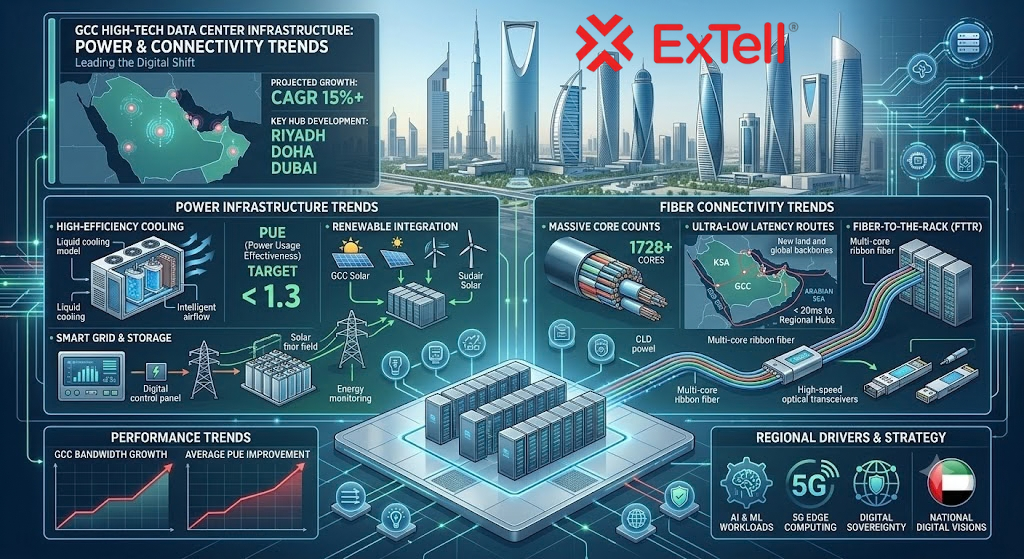
Data Center Infrastructure in the GCC: Power, Fiber and Connectivity Trends in 2026
The Gulf Cooperation Council (GCC) is becoming an increasingly important market for data centers, cloud computing, artificial intelligence, and digital infrastructure.
In 2026, countries across the GCC are investing heavily in digital transformation and AI capabilities. This growth is increasing demand for reliable data center infrastructure in the GCC, including critical power systems, fiber connectivity, networking equipment, cooling, and resilient physical infrastructure.
The UAE and Saudi Arabia remain major centers of data-center development, while Qatar, Bahrain, Kuwait, and Oman are also developing their digital infrastructure capabilities. Recent industry analysis estimates that the wider GCC data-center market could grow substantially through 2030, with capacity currently concentrated particularly in the UAE and Saudi Arabia.
So, what are the most important data center infrastructure trends in the GCC in 2026?
Three areas stand out: power resilience, high-capacity fiber connectivity, and scalable networking infrastructure.
Why Is Data Center Infrastructure Growing in the GCC?
Several factors are driving data-center demand across the Gulf region.
These include:
- Cloud computing
- Artificial intelligence
- Digital government services
- Financial technology
- 5G and telecommunications
- Enterprise digitization
- Content delivery
- Regional cloud services
- High-performance computing
The GCC also has a strategic geographic position between Europe, Asia, and Africa. Major submarine fiber routes connect the region to global markets, giving Gulf data centers an important role in regional and international connectivity.
This combination of digital investment, geographic location, energy resources, and expanding cloud and AI workloads is increasing the importance of robust data-center infrastructure.
What Are the Key Data Center Infrastructure Trends in the GCC in 2026?
The main trends can be grouped into three connected areas:
- Reliable and scalable power
- High-capacity fiber connectivity
- Resilient and scalable networking
Each plays a different role, but all are necessary for modern data-center operations.
1. Reliable Power Is Becoming More Important
Data centers cannot operate without continuous electrical power.
Servers, storage systems, networking equipment, cooling systems, security systems, and other critical infrastructure all depend on stable electricity.
As AI workloads become more power-intensive, the importance of power planning is increasing further.
Large AI data-center projects in the UAE and Saudi Arabia are creating electricity loads at a scale that is putting additional attention on power procurement, grid capacity, backup systems, and energy planning.
For data-center operators, this means power infrastructure needs to be designed around both current loads and future expansion.
What Power Systems Do Data Centers Need?
A modern data center may use multiple layers of power protection, including:
- Utility power
- Generators
- UPS systems
- Battery systems
- Power distribution units
- Automatic transfer systems
- Monitoring systems
- Redundant electrical paths
An uninterruptible power supply (UPS) is particularly important because it can provide immediate backup power and protect sensitive equipment from power disturbances.
ExTell Systems currently offers modular UPS solutions with N+1 and N+N redundancy options, designed for scalable critical-power environments including data centers and telecom infrastructure.
2. AI Is Increasing Data Center Power Requirements
Artificial intelligence is changing data-center design.
AI servers and GPU clusters can require substantially more power than many traditional enterprise workloads. This creates additional requirements for electrical distribution, backup power, cooling, and physical space.
In the GCC, this trend is particularly important because the region is actively positioning itself as a hub for AI and cloud infrastructure.
Recent developments include large-scale AI and data-center investments in the UAE and Saudi Arabia.
For infrastructure planners, the lesson is straightforward: power capacity should be planned for future computing requirements, not only today’s server load.
3. Fiber Connectivity Is Becoming a Core Requirement
Power keeps a data center operating, but connectivity moves the data.
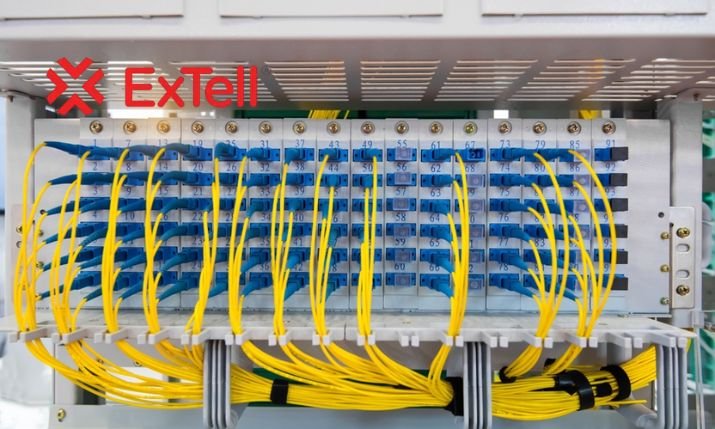
Modern data centers depend on fiber optic infrastructure for high-speed communication between servers, network switches, storage systems, buildings, campuses, and external networks.
The GCC’s geographic position makes fiber particularly important.
The region sits along major international submarine cable routes connecting Europe, Asia, and Africa. Fiber therefore supports both local data-center connectivity and international data flows.
In May 2026, Ooredoo Group and du announced the landing of the Fibre in the Gulf (FIG) subsea cable system in the UAE. The system is designed for up to 720 Tbps across 24 fiber pairs and is intended to support hyperscalers, cloud providers, AI platforms, and data-center operators across the region.
This illustrates how fiber capacity is becoming a strategic part of GCC digital infrastructure.
4. High-Density Fiber for Growing Data Centers
As data centers become larger, the number of network connections also increases.
AI clusters can require large numbers of connections between computing resources, switches, storage systems, and other infrastructure.
This makes fiber density increasingly important.
Data-center designers should consider:
- Fiber count
- Rack density
- Cable pathways
- Patch-panel capacity
- Connector density
- Cable management
- Redundant routes
- Future expansion
ExTell’s current fiber portfolio includes enterprise-grade fiber cables, including armored fiber backbone products, supporting different deployment requirements.
5. Data Center Interconnect Is Expanding
Data Center Interconnect (DCI) refers to the network infrastructure used to connect separate data centers.
In the GCC, DCI can support:
- Disaster recovery
- Cloud connectivity
- Business continuity
- Workload distribution
- Data replication
- Regional services
- AI infrastructure
Connecting multiple facilities can also help organizations create more resilient architectures instead of depending entirely on one physical location.
This is becoming increasingly relevant as large-scale digital infrastructure expands across the Gulf.
6. Redundancy and Resilience Are Becoming Essential
A data center needs more than high performance. It also needs resilience.
Infrastructure designers increasingly consider redundancy across power, connectivity, cooling, and physical routes.
For example, a resilient architecture may include:
- Dual power feeds
- N+1 or N+N UPS systems
- Backup generators
- Redundant fiber routes
- Multiple network providers
- Separate equipment rooms
- Backup cooling capacity
- Geographic redundancy
The exact design depends on the business requirements and applicable data-center standards.
In 2026, resilience has become an even more visible consideration because GCC data-center projects are increasingly supporting critical AI, cloud, government, and enterprise workloads. Recent reporting also shows operators reassessing physical resilience and backup infrastructure for major AI facilities in the region.
7. Energy Efficiency Is Part of the Infrastructure Strategy
Data centers consume significant amounts of electricity, so efficiency is becoming an important consideration.
Operators can look at:
- High-efficiency UPS systems
- Efficient power distribution
- Intelligent monitoring
- Renewable energy integration
- Battery energy storage
- Efficient cooling
- Server utilization
- Power usage effectiveness
In the GCC, energy planning is especially relevant because data-center expansion is happening alongside broader investments in renewable energy and energy-storage systems.
Industry analysis points to solar, battery energy storage, and other behind-the-meter solutions as potential components of the region’s response to growing data-center loads.
8. Scalable Infrastructure Is Critical for Future Growth
Data-center infrastructure should not be designed only for the initial deployment.
Cloud services, AI applications, and enterprise workloads can grow quickly. Infrastructure therefore needs room for expansion.
A scalable data-center strategy should consider:
- Future IT load
- Additional racks
- Increased fiber capacity
- UPS expansion
- Battery requirements
- Cooling capacity
- Network upgrades
- Additional physical space
Modular infrastructure can make expansion easier because additional capacity can be introduced without completely redesigning the existing facility.
How Should Businesses Plan Data Center Infrastructure in the GCC?
Organizations planning a GCC data-center project should evaluate the complete infrastructure rather than considering power and connectivity separately.
A practical approach includes:
Assess Power Requirements
Calculate current and projected IT loads and determine appropriate UPS, battery, generator, and distribution requirements.
Plan Fiber Connectivity
Determine current bandwidth requirements, fiber counts, network routes, and future expansion needs.
Build Redundancy
Identify which systems require N+1, N+N, dual-path, or geographically separated configurations.
Consider Location
Evaluate connectivity to telecom networks, cloud providers, customers, and other facilities.
Plan for AI and Cloud Growth
Even if the initial workload is conventional enterprise computing, infrastructure should allow for future high-density computing and AI workloads.
Monitor Infrastructure
Power quality, UPS performance, battery health, network availability, and environmental conditions should be monitored continuously where appropriate.
How ExTell Systems Supports GCC Data Center Infrastructure
ExTell Systems provides power backup, fiber, networking, and data-center infrastructure solutions for critical environments. Its current portfolio includes UPS systems, fiber cables, fiber accessories, networking products, power electronics, and data-center solutions.
ExTell also has regional operations in the UAE and Bahrain, supporting its presence in the GCC market.
This combination of power and ICT infrastructure can help organizations approach data-center projects as an integrated infrastructure requirement rather than a collection of individual components.
Frequently Asked Questions
1. What are the main data center infrastructure trends in the GCC in 2026?
Major trends include increasing demand for reliable power, AI-ready infrastructure, high-capacity fiber connectivity, data-center interconnects, redundancy, energy efficiency, and scalable infrastructure.
2. Why is fiber important for GCC data centers?
Fiber provides high-capacity connectivity for data centers, cloud services, telecom networks, AI workloads, and connections between geographically separated facilities.
3. Why do GCC data centers need UPS systems?
UPS systems provide backup power and protection against power disturbances. They can help keep critical IT equipment operating during short power interruptions and support controlled transitions to longer-duration backup systems.
4. How is AI changing data center infrastructure in the GCC?
AI can increase requirements for computing capacity, power, cooling, network bandwidth, and high-density connectivity. This is encouraging data-center operators to plan infrastructure with higher future capacity.
5. How can businesses future-proof a GCC data center?
Businesses can plan for future power loads, reserve fiber capacity, use scalable UPS architectures, design redundant network routes, and allow sufficient space for additional computing and infrastructure equipment.
Explore More from ExTell Systems
https://extellsystems.com/contact
https://extellsystems.com/about
Sales mail :- sales@extellsystems.com
Build a Reliable GCC Data Center Infrastructure Strategy
The GCC data-center market is entering an important phase of growth in 2026. AI, cloud computing, telecom connectivity, and digital transformation are increasing the need for infrastructure that can deliver reliable power, high-capacity fiber, scalable networking, and resilient operations.
Power and connectivity should not be treated as separate decisions. A strong data-center strategy brings UPS systems, fiber infrastructure, networking, redundancy, monitoring, and future expansion together.
Planning a data center, AI facility, telecom project, or enterprise infrastructure deployment in the GCC? Contact ExTell Systems to discuss your power backup, fiber, networking, and data-center infrastructure requirements and build a scalable solution for your next project.