UPS vs Generator: What Businesses Need for Reliable Power Backup?
Reliable power is essential for modern businesses. Data centers, offices, telecom facilities, industrial sites, healthcare environments, and other critical operations depend on electricity to keep equipment and services running.
When the main power supply fails, businesses often consider two important backup options: a UPS and a generator.
But what is the difference between a UPS and a generator? Can a UPS replace a generator? Or should businesses use both?
The answer depends on the type of equipment, required backup duration, power demand, and business continuity strategy.
A UPS and a generator perform different roles. A UPS can provide immediate backup power and help protect connected equipment during short interruptions. A generator can provide power for a longer period when the utility supply is unavailable, provided it has fuel and is properly integrated into the electrical system.
For many critical facilities, combining both technologies can provide a more complete power backup solution.
What Is a UPS?
A UPS, or Uninterruptible Power Supply, is a power protection system that provides backup power when the primary electrical supply is interrupted.
The UPS uses batteries to supply power to connected equipment. Depending on the UPS design, it can also help manage certain power-quality issues such as voltage fluctuations.
UPS systems are commonly used for:
- Servers and data center equipment
- Network switches and routers
- Telecom infrastructure
- Security and surveillance systems
- Industrial control equipment
- Critical business systems
- IT and communication equipment
One of the main advantages of a UPS is its ability to provide backup power immediately when the main supply is interrupted.
What Is a Generator?
A generator produces electrical power using an engine and fuel source. It is generally designed to provide backup electricity for longer periods than a battery-based UPS.
Generators are commonly used for:
- Commercial buildings
- Industrial facilities
- Data centers
- Telecom sites
- Manufacturing operations
- Healthcare facilities
- Large infrastructure installations
The available runtime depends on factors such as fuel capacity, generator size, connected load, operating conditions, and fuel supply.
Unlike a UPS, a generator normally requires time to start and reach the required operating condition before it can supply backup power.
UPS vs Generator: What Is the Main Difference?
The key difference is how each system provides backup power.
A UPS uses stored electrical energy, typically from batteries, to provide immediate backup power.
A generator produces electricity using an engine and fuel, making it suitable for longer-duration backup.
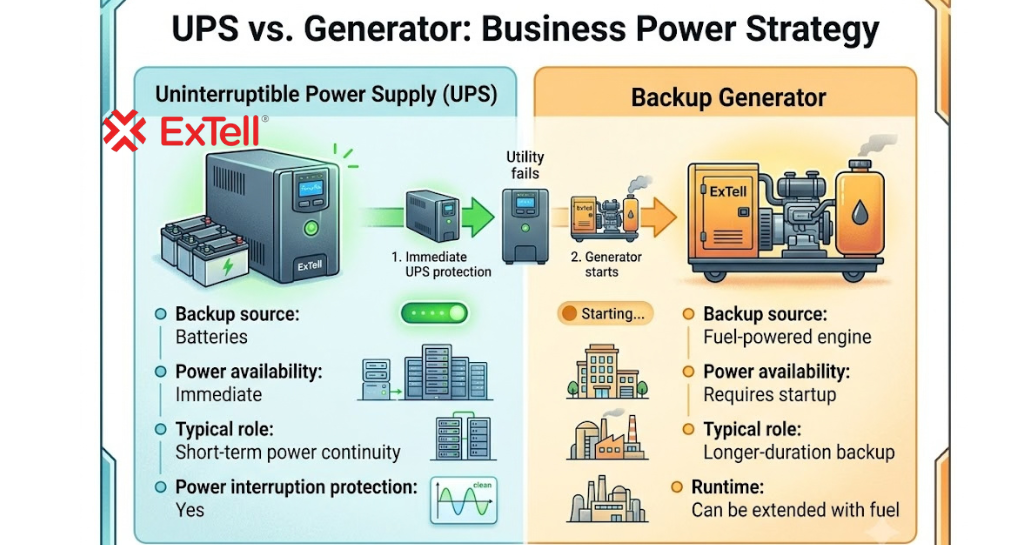
Here is a simple comparison:
| Feature | UPS | Generator |
|---|---|---|
| Backup source | Batteries | Fuel-powered engine |
| Power availability | Immediate | Requires startup |
| Typical role | Short-term power continuity | Longer-duration backup |
| Power interruption protection | Yes | Requires transfer/startup system |
| Runtime | Limited by battery capacity and load | Can be extended with fuel supply |
| Common use | IT, networking, critical electronics | Buildings, industrial and larger loads |
| Maintenance | Batteries and UPS equipment | Engine, fuel and generator systems |
The two technologies should not necessarily be viewed as competing products. In many critical applications, they work together.
Can a UPS Replace a Generator?
In most applications, a UPS should not automatically be considered a replacement for a generator.
A UPS can provide immediate power during an outage, but its runtime is limited by battery capacity and connected load.
A generator can operate for a much longer period when sufficient fuel is available.
For example, a facility may use a UPS to keep servers and networking equipment operating immediately after a power failure. A generator can then provide longer-duration power after starting and transferring the load.
This combination can help create a layered backup strategy.
Why Do Businesses Use UPS and Generator Together?
Using both systems can address different stages of a power interruption.
A typical sequence may work like this:
Utility power fails → UPS immediately supports critical loads → generator starts → electrical system transfers to generator power → UPS continues supporting the protected load.
When utility power returns, the system can transfer back according to the facility’s electrical design and control strategy.
This approach can be useful for environments where even a short interruption can affect critical operations.
When Is a UPS More Important?
A UPS becomes particularly important when equipment cannot tolerate even a short interruption.
IT equipment, servers, networking devices, communication systems, and other electronic equipment may require continuous power during a transition between electrical sources.
A UPS can also provide power-quality functions depending on its technology and configuration.
For businesses that depend heavily on digital infrastructure, UPS protection can therefore be an important part of business continuity planning.
When Is a Generator More Important?
A generator becomes particularly valuable when a facility needs backup power for an extended outage.
Large buildings, industrial operations, telecom infrastructure, data centers, and other facilities may have electrical loads that cannot be supported by batteries for long periods.
Generators can provide longer-duration backup when properly sized, fueled, maintained, and integrated with the facility’s electrical infrastructure.
However, generator selection requires careful consideration of load requirements, starting loads, fuel systems, transfer equipment, ventilation, installation conditions, and maintenance.
How Do You Choose Between a UPS and Generator?
Instead of asking only whether a UPS or generator is better, businesses should first understand their power requirements.
Consider these questions:
1. What equipment needs backup power?
Identify critical servers, networking systems, machines, security equipment, communication systems, and other loads.
2. How long must the equipment remain operational?
If only a short transition period is required, UPS capacity may be the primary consideration. For extended outages, a generator may also be required.
3. How much power is required?
Calculate the total connected load and consider peak demand and future expansion.
4. Can the equipment tolerate an interruption?
If even a brief interruption can cause operational problems, immediate UPS protection may be important.
5. Is generator integration required?
For facilities requiring extended backup, consider how the UPS, generator, transfer equipment, batteries, and electrical distribution system will work together.
What Role Do Batteries Play in Power Backup?
Batteries are an essential part of a UPS system.
Battery capacity determines how much backup energy is available for the connected load. Runtime depends on factors such as battery capacity, load level, battery condition, temperature, and system configuration.
Businesses should consider:
- Required runtime
- Battery capacity
- Battery cabinets
- Battery monitoring
- Replacement planning
- Maintenance requirements
- Available installation space
Proper battery planning is important for maintaining predictable UPS performance over the system’s lifecycle.
How Does Monitoring Improve Backup Power Management?
Modern power infrastructure can benefit from monitoring and communication systems.
UPS monitoring can provide information about system status, load, battery condition, alarms, and other operating parameters, depending on the equipment and configuration.
Monitoring can help technical teams identify potential issues, plan maintenance, and maintain better visibility into critical power infrastructure.
For larger facilities, UPS monitoring can be integrated into broader infrastructure or facility management systems where appropriate.
Why Is a Complete Power Backup Strategy Important?
Reliable backup power is not based on one piece of equipment.
A complete strategy may include:
- UPS systems
- Batteries
- Battery cabinets
- Generators
- Power distribution
- Monitoring systems
- Redundancy
- Preventive maintenance
- Technical support
- Future capacity planning
The right combination depends on the organization’s operational requirements and infrastructure.
How ExTell Systems Supports Power Backup and ICT Infrastructure
ExTell Systems is an international Power Backup Solutions and ICT manufacturer with offices in the UAE, Bahrain, USA, and India.
Its solution portfolio includes:
- Power Electronics
- Batteries
- Battery Cabinets
- Network Racks
- Structured Cabling
- Accessories
- Greenfield Solutions
For businesses planning reliable infrastructure, power backup should be considered alongside networking and ICT requirements.
A well-planned solution can bring together power protection, batteries, infrastructure equipment, monitoring, and future expansion requirements.
Frequently Asked Questions
1. What is better for business backup power, a UPS or generator?
A UPS and generator serve different purposes. A UPS provides immediate battery-based backup, while a generator is designed for longer-duration power generation. The appropriate solution depends on the facility’s requirements.
2. Can a UPS and generator work together?
Yes. A UPS can provide immediate power during an outage while a generator starts and takes over the longer-duration backup role, when the systems are properly designed and integrated.
3. How long can a UPS provide backup power?
UPS runtime depends on battery capacity, connected load, battery condition, and system configuration. Larger battery systems can provide longer runtime.
4. Does a generator provide instant backup power?
A generator normally requires startup and transfer time. A UPS can provide immediate battery backup during this transition.
5. Do data centers need both UPS and generators?
Many data center power strategies use both technologies because they address different backup requirements. The final configuration depends on the data center’s load, availability requirements, infrastructure design, and continuity strategy.
Explore More from ExTell Systems
https://extellsystems.com/contact
https://extellsystems.com/support
Sales mail :- sales@extellsystems.com
Build a Reliable Power Backup Strategy
A UPS and a generator are not simply alternatives. They can perform different roles within a complete power protection strategy.
A UPS can provide immediate battery-based backup and help protect critical electronic equipment, while a generator can support longer-duration power requirements. When designed and integrated correctly, both can contribute to a more resilient backup power system.
Whether you operate a data center, industrial facility, telecom site, commercial building, or other critical infrastructure, selecting the right combination of UPS, batteries, generator support, monitoring, and power infrastructure is an important step toward business continuity.
Contact ExTell Systems today to discuss your power backup requirements and develop a reliable solution designed around your critical operations.
ExTell Systems — Power Backup and ICT Solutions for Critical Infrastructure.